COLOUR THEORY
The colour theory is a body of practical guidance to colour mixing and the visual effects of specific colour combination. There are also definitions (or categories) of colours based on the colour wheel: primary colours, secondary colours and tertiary colours.
PRIMARY COLOURS
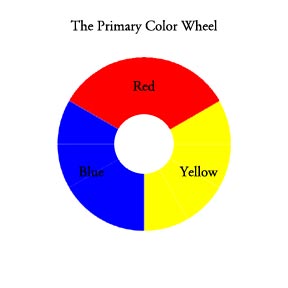
Any of a group of colours from which all other colours can be obtained by mixing. The three primary colours are red, blue and yellow
SECONDARY COLOURS
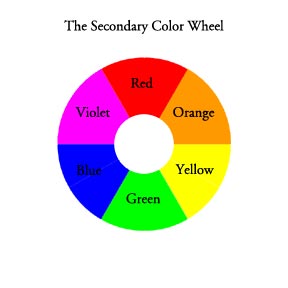
A colour produced by mixing two additive primary colours in equal proportions. The secondary colours are Violet, Orange and Green.
TERTIARY COLOUR
A tertiary colour or quaternary colour (called intermediate colours) is a colour made my mixing either one primary colour with one secondary colour, or two secondary colours.

ANALOGOUS COLOURS
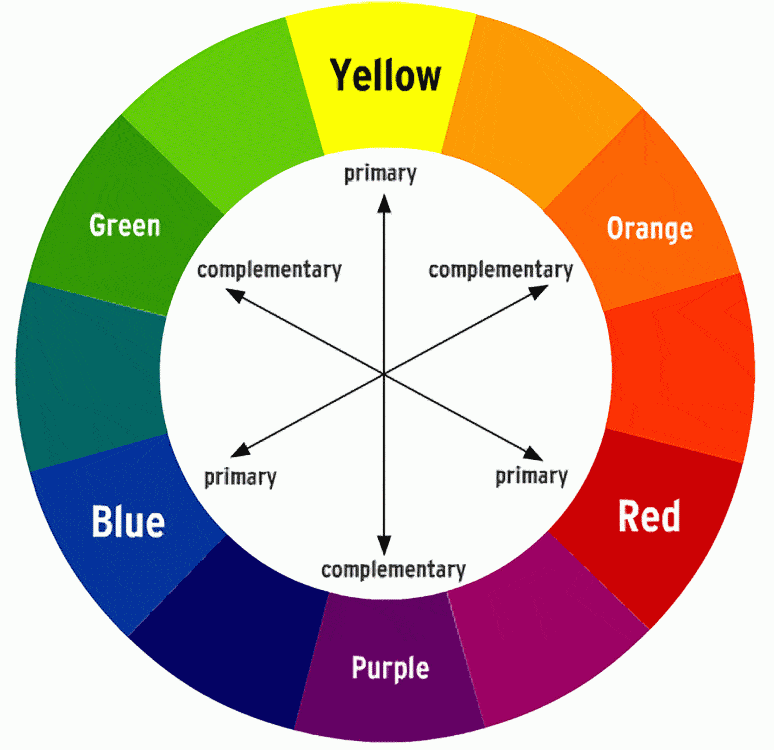
Analogous colours are any three colours which are side by side on a 12 part colour wheel, such as yellow-green, yellow and yellow-orange. Usually one of the three colours predominates

COMPLEMENTARY COLOURS
Analogous colours are any three colours which are side by side on a 12 part colour wheel, such as yellow-green, yellow and yellow-orange. Usually one of the three colours predominates

COMPLEMENTARY COLOURS
ACHROMATIC COLOURS
Achromatic is used as a synonym for "black and white". A black and white print has shades of grey, but greyscale is also considered to be achromatic because it lacks hue, which means it cannot be classified as a subset of the colours red, green, blue or yellow.

CHROMATIC COLOURS
Blue and green are chromatic colours, while white, grey and black are achromatic, as they have no dominant hue (all wavelengths are present in equal amounts within those colours). White light is considered achromatic, as it possesses no dominant hue.

MONOCHROMATIC COLOURS
Monochromatic colours are all the colours (tints, tones and shades) of a single hue. Monochromatic colour schemes are derived from a single base hue and extended using its shades, tones and tints. Monochromatic colour schemes use variations in lightness and saturation of a single colour. This scheme looks clean and elegant. The colours go well together, producing a soothing effect.
 |
COOL AND WARM COLOURS Warm colours are made with orange, red, yellow and combinations of them all. As the name indicates, they tend to make you think of sunlight and heat. Warm colours look as though they come closer. Cool colours such as blue, green and light purple have the ability to calm and soothe. Where warm colours remind us of heat, cool colours remind us of water and the sky.  NEUTRAL COLOURS Neutral colours include black, white, grey and sometimes brown and beige. Mainly colours associated with skin tones. They are sometimes called earth tones. |


No comments:
Post a Comment